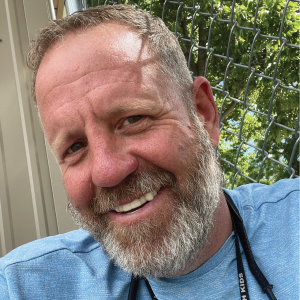
 “It took me a long time to find my purpose,” Josh says. “I always knew I wanted to be a teacher, but I took a lot of different turns before I fulfilled my goal.” Josh’s roundabout route took him to Japan, where he was a Marine; to Nevada’s oil fields, where he worked in quality control; and to Subaru in Butte, Montana, where he worked as a car sales manager until 2019. “The job paid well, but I hated every minute of it,” Josh recalls, “and when COVID hit, I decided it was time to finally do what I’d wanted to all along.”
At the age of 45, Josh became a professional in early learning, and in the six years since then his focus has been on supporting children who are neurodivergent or have experienced trauma in their lives. There are many children like this at Family Tree Nurturing Center in Billings, Montana, where Josh now serves as director. He supports Head Start children from marginalized communities, and the challenges that the children often face strike a chord in Josh because he has personal experience of what they’re going through.
“I had attention deficit/hyperactivity disorder (ADHD) as a child,” he recalls, “but that condition wasn’t on the radar while I was growing up in a small Montana town of 500 people. Nobody understood why I was so ill behaved, and I spent a lot of time in the principal’s office while I was growing up. I didn’t receive a formal diagnosis until I was in my forties, and that’s what makes me so determined to support children whose brains aren’t wired the same way as typical young learners,” Josh says. “I know the feelings that come from having cognitive, behavioral or developmental issues, so any child who faces these challenges is near and dear to me,” Josh says. “I want children like this to feel safe in my program and make sure their families have all the support that they need.”
Josh knows what it’s like to be the parent of a neurodivergent child because his stepson, Jaxtin, suffered a traumatic brain injury as a baby, leading him to have ADHD and be on the autism spectrum. “I came into Jaxtin’s life when he was a little over a year old, and the wish to be present for him helped lead to a turning point in my life,” Josh recalls. “The wish to be present for Jaxtin and closing of my car dealership during the pandemic converged to usher me into the early childhood field,” Josh recalls. “Six years ago, I began working at Friendship House of Christian Services in Billings, the early childhood program that Jaxtin attended.”
The program gave Josh a lot of chances to pursue his passion for helping young children with challenging behaviors, as he recalls. “Many of the children I served couldn’t keep their hands to themselves or struggled to regulate their bodies. They had parents who had substance abuse issues or were in prison, so it wasn’t easy to serve them,” Josh admits. But, based on his experience with Jaxtin, Josh had some ideas for how to assist them. “Breathing, tapping and counting helped. So did having the child take a break or a walk,” as Josh explains.
He has known even more about how to help children with challenging behaviors since earning a CDA® through Montana’s registered CDA apprenticeship program last year. “The CDA coursework helped me understand how a child’s brain works and how to communicate more effectively with a child, whether through modeling or direct speech,” Josh says. “I also learned how to rewire the synapses in children’s brains to lead to more positive outcomes. I was especially interested in what the CDA courses taught me about social and emotional learning since I believe that’s the most crucial thing educators do in an early childhood classroom,” Josh points out. “We are teaching children how to identify their feelings and be able to express them in positive ways.”
Josh showed his own knowledge of social and emotional learning while serving a little girl at Friendship House who struggled with abandonment issues when her parents dropped her off in the morning. “There was lot of crying and emotional escalation every day,” Josh recalls, so he worked with the parents to come with a plan to make drop-offs less stressful. “We decided that the parents would come in 15 minutes earlier in the morning, walk their daughter to the classroom and spend the extra time playing with her. Five minutes before leaving, the parents would ask the child if there was anything else she needed, and this slight change in routine made a world of difference for the child.”
So did the steps Josh took to help a small boy named Timothy whose biological mom had substance abuse issues. Timothy had been through a lot of traumas by the time a foster family adopted him. “He struggled with self-regulation,” Josh says, “so I worked with the parents to identify ways to improve his attention span and impulse control both at home and school. One of the things that worked was touching Timothy on the shoulder or placing a hand on his arm to let him know he needed to pay attention or not interrupt when someone was talking,” Josh explains. “I also took steps to get Timothy assessed by a pediatrician, who gave him a diagnosis of ADHD. Since then, Timothy has received the therapy, support and medication he needs to succeed in school.”
Timothy’s struggles made Josh think back to the challenges he’d faced as a child, as do the roadblocks that children face at Family Tree Nurturing Center, where Josh has served as director since September of 2025. In this recent role, Josh shares his techniques for addressing behavioral challenges with his staff and makes partnering with parents a key part of the center’s program. “We encourage parents to make a commitment to read aloud for 10 minutes a day if a child struggles with reading. If a child struggles with shapes and colors, we also encourage the parents to commit to working on that issue for 10 minutes a day,” Josh says.
In addition, the center holds parenting classes and has family advocates who do everything they can to support families, from helping with transportation to addressing situations where there’s domestic abuse. “The point of these efforts is to bridge the gap between families and educators because I look at myself and my staff as an extension of the families,” Josh says. “Whatever affects the child affects us all.”
Josh also considers the efforts he makes for children as a way to recover from the lingering wounds he suffered as a child with ADHD. “Every day, as we show up for the children in our lives, we’re also given a chance to show up for our inner child, reminding them they are safe, worthy and still growing,” Josh says. And Josh is still growing, too, as he strives to make up for the years he lost before finding his purpose late in life.
As Josh looks to the future, he’s inspired by the Welsh poet Dylan Thomas, who wrote a famous poem about growing older, Do Not Go Gentle into The Good Night. Thomas urged us to “rage, rage against the dying of the light,” words that mean a lot to Josh. “Some day when my time has come to an end,” he says, “I don’t want to look back and regret not doing enough for children. I’m determined to rage, rage and work on their behalf until the light goes out.”