“The CDA was everything for me,” says Buddy Rhodes, an educational site coordinator at a Head Start program in Virginia. “I’ve known I loved teaching since I was in high school and helped out in my mother’s third-grade classroom,” Buddy recalls. He also knew he needed skills if he was to succeed in his chosen profession. “The CDA gave me the confidence to gain my college degree and advance my career. Without the CDA, I don’t think I would be where I am today.”(1)
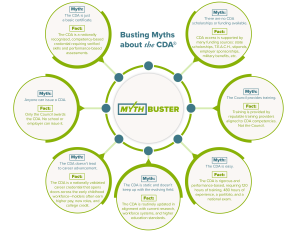
Buddy’s success story isn’t unique since the Child Development Associate® (CDA) Credential™ has made an impact on educators for more than five decades.(2) In those many years, myths have sprung up about the steps required to earn a CDA, the effort it takes and the credential’s value. After hearing from stakeholders in the early learning field, we’ve seen that some misconceptions abound:
The CDA is just a basic certificate.
The CDA can be issued and renewed by numerous organizations.
The CDA is easy.
The CDA is static and doesn’t keep up with the changing field.
The CDA doesn’t lead to career advancement.
The Council for Professional Recognition provides training.
There are no CDA scholarships or funding available.
Now it’s time to clear the air as families and center directors across the country call for competent educators like those who earn a CDA. This rising demand makes it important to bust the myths about the CDA by laying down the facts.
The CDA is a credential, not a certificate, meaning that it holds educators to a higher standard. Certificate programs educate people about one aspect of their field and often come from a place where they take coursework. A credential, on the other hand, is proof of a person’s competence in an entire field and ability to manage any challenges of their profession. Credentials also carry more weight because a third party awards them, based on a demonstration that a person can effectively do their job.
That’s a crucial yardstick to keep in mind when it comes to our precious youngest children, so only the Council can issue a CDA. We require candidates to prove they can perform in the classroom by meeting a set of time-tested standards: 120 hours of coursework, 480 hours of experience, completion of a portfolio, an assessment by a CDA Professional Development Specialist™ and a passing score on a national exam.(3)
As candidates proceed through the CDA process they can take coursework from a wide range of training organizations and educational institutions. Still, the Council has the final say in whether an educator has the skills to hold or renew a CDA, an essential part of staying up to date in the early learning field. And the Council doesn’t make these decisions lightly.(4) It takes work to earn a CDA, “but it’s so worth it,” says Jada Vargas, the Council’s millionth CDA. “If you keep going forward, you will see the benefit of your CDA journey to a career in ECE.”(5)
Earning a CDA helps educators find jobs, and the Council has data to prove it. Based on our 2022 CDA Credential Holders Survey, 80 percent of owners and directors are more likely to hire someone with a CDA than someone without it, and one program owner summed up the reasons why. “It shows that an educator is dedicated, knowledgeable and willing to put in the effort because it’s a lot of work to earn a CDA.”(6)
It also pays off by helping CDA holders progress in their careers, according to 73 percent of the CDA earners we surveyed. Half of employers pay CDAs more than their noncredentialled colleagues. And many get promotions, often to lead teachers. Still, educators realize that holding a CDA is about more than pay and promotions. Earning a CDA, as 60 percent of respondents pointed out, is also a way for educators to expand their skills and serve young children better.(7)
The Council wants to help educators reach this goal, by giving them the latest guidance and tools, so we’re constantly looking for ways to enhance the CDA credential. Research has long been at the forefront of our efforts, including our CDA holder surveys and ongoing work to reimagine the CDA by making the credentialing process more streamlined and efficient.(8) Most recently, the Council selected the Stanford Center on Early Childhood to conduct an extensive research project to understand the impact of the CDA on educator outcomes.(9)
That begins by giving educators the support to improve their skills, as many states have already done by providing funding for potential CDAs. Many of these CDA scholarships appear on the Council’s website(10) and we put a spotlight on them in our CounciLINK newsletter, where we feature the programs and people who shape our field. CDA partners, as they’re called, include the Michigan Association for the Education of Young Children, which provides funds to cover CDA fees,(11) and the Ohio Child Care Resource & Referral Association, which provides coaching and financial aid to almost 1,000 people a year to ensure they complete the credentialing process.(12)
“Insisting on success” is the tagline of Delaware’s Early Childhood Innovation Center where they’re using much of a $31.6 million state grant to advance the CDA. “We believe educators will continue to grow after taking that first step by earning a CDA,” says Kimberly Krzanowski, the center’s executive director. “Research shows that many CDA holders go on to earn their bachelor’s degree, so we’re ready to change people’s lives by helping them earn the Council’s credential.”(13)
Earning a CDA changed Buddy Rhodes’ life, as we’ve seen, and educators like him aren’t the only ones who benefit when states support the CDA. Educators with CDAs also produce better outcomes for children as research has shown since 1985.(14) This is because CDAs know more about how children develop and are better prepared for the classroom, as 80 percent of owners and directors agreed in our latest survey.(15) And data like this should dispel the myths when states consider investing in the CDA credential. Earning a CDA leads to concrete results for both educators and for the children they serve.
Hawaii faces a documented shortage of qualified early childhood educators, particularly on neighbor islands and in rural communities leaving many children and families without access to needed care. With a shortage of licensed child care...
Download Your New CDA® Exam Study Guide Now! The Council for Professional Recognition, the organization that administers the CDA® credential, is excited to share the new CDA® exam study guide. This free resource uses research, standards,...
An International Women’s Day Tribute to an Early Childhood Icon International Women’s Day invites us to pause and honor women whose courage and vision have changed the course of history. In our field of early...
Now it’s time to clear the air as families and center directors across the country call for competent educators like those who earn a CDA. This rising demand makes it important to bust the myths...
Each February, the accomplishments of Career and Technical Education (CTE) programs and the importance of “CTE for all students of all ages” as ACTE indicates, are celebrated. CTE Month is a time to honor the...
A new year brings new opportunities to reach your professional goals. Are you looking to boost your competence and confidence as an early educator in 2026? Consider making an addition to your New Year’s resolutions:...
The beginning of each new year brings new opportunities to reset and reimagine the vitality of your program and to reengage your community – children, families, and staff. It’s the perfect time to plan experiences...
Twenty-month-old Everly leans on Ms. Sarah’s lap in the young toddler classroom. Ms. Sarah enjoys supporting Everly’s language skills and playing “Pat-a-Cake” as Everly giggles. She assists Everly in rolling gently from side to side...
Strengthening Integrity, Objectivity, and Efficiency in the CDA® Credentialing Process At the Council for Professional Recognition, we remain steadfast in our commitment to the integrity, objectivity and quality of the Child Development Associate® (CDA) Credential™,...
Mackenzie Pelland
Vice President of Product
Mackenzie Pelland serves as Vice President of Product at the Council. In this role, she oversees the Council’s product strategy and portfolio, including credentialing programs, educational publications, professional development resources, and branded merchandise, ensuring offerings are sustainable and responsive to the evolving needs of early childhood educators and the broader early care and education field. Her work focuses on building scalable, user-centered products that strengthen quality and integrity across the Council’s credentialing, educational, and professional learning offerings.
Prior to this role, Mackenzie served as Director of ECE Observation Systems at the Council, where she oversaw the observation portion of the CDA® credentialing assessment process and led the ECE Observation Team. She also worked to support, refine, and strengthen the Professional Development Specialist community to better meet the needs of a diverse CDA® candidate population.
Before joining the Council, Mackenzie was Senior Director of Monitoring and Compliance Systems at Acelero Learning, where she led the development and execution of monitoring systems related to federal grant compliance, child care licensing, health and safety, incident management, and facilities compliance across Head Start programs nationwide. She also previously served as Program Accountability and Policy Implementation Manager at New York City’s Department of Education within the Division of Early Childhood Education.
Mackenzie is recognized as a credentialing specialist by the Institute for Credentialing Excellence. She holds a master’s degree in education policy from Teachers College, Columbia University, a Certificate in Education and Program Evaluation from Georgetown University, and a bachelor’s degree in politics and education from Occidental College.
Elisa Shepherd
Vice President of Strategic Alliances
Elisa Shepherd is the Vice President of Strategic Alliances at the Council, where she leads initiatives to advance the Council’s mission and strategic plan through designing, managing, and executing a comprehensive stakeholder relationship strategy.
With over 25 years of experience in early childhood education (ECE), Elisa has dedicated her career to developing impactful programs, professional development opportunities, and public policies that support working families, young children, and ECE staff. Before joining the Council, Elisa held numerous roles within the childcare industry. Most recently, she served as Associate Vice President at The Learning Experience and as Senior Manager at KinderCare Education, where she influenced government affairs and public policies across 40 states.
Elisa’s commitment to leadership is reflected in her external roles on the Early Care and Education Consortium Board of Directors, the Florida Chamber Foundation Board of Trustees, and as the DEI Caucus Leader for KinderCare Education. She has been recognized as an Emerging Leader in Early Childhood by Childcare Exchange’s Leadership Initiative.
Elisa earned a Bachelor of Science in Psychology with a focus on child development from Pennsylvania State University in State College, PA.
Janie Payne
Vice President of People and Culture
Janie Payne is the Vice President of People and Culture for the Council for Professional Recognition. Janie is responsible for envisioning, developing, and executing initiatives that strategically manage talent and culture to align people strategies with the overarching business vision of the Council. Janie is responsible for driving organizational excellence through strategic talent practices, orchestrating workforce planning, talent acquisition, performance management as well as a myriad of other Human Resources Programs. She is accountable for driving effectiveness by shaping organizational structure for optimal efficiency. Janie oversees strategies that foster a healthy culture to include embedding diversity, equity, and inclusion into all aspects of the organization.
In Janie’s prior role, she was the Vice President of Administration at Equal Justice Works, where she was responsible for leading human resources, financial operations, facilities management, and information technology. She was also accountable for developing and implementing Equal Justice Works Diversity, Equity, and Inclusion strategy focused on attracting diverse, mission-oriented talent and creating an inclusive and equitable workplace environment. With more than fifteen years of private, federal, and not-for-profit experience, Janie is known for her intuitive skill in administration management, human resources management, designing and leading complex system change, diversity and inclusion, and social justice reform efforts.
Before joining Equal Justice Works, Janie was the Vice President of Human Resources and Chief Diversity Officer for Global Communities, where she was responsible for the design, implementation, and management of integrated HR and diversity strategies. Her work impacted employees in over twenty-two countries. She was responsible for the effective management of different cultural, legal, regulatory, and economic systems for both domestic and international employees. Prior to Global Communities, Janie enjoyed a ten-year career with the federal government. As a member of the Senior Executive Service, she held key strategic human resources positions with multiple cabinet-level agencies and served as an advisor and senior coach to leaders across the federal sector. In these roles, she received recognition from management, industry publications, peers, and staff for driving the creation and execution of programs that created an engaged and productive workforce.
Janie began her career with Verizon Communications (formerly Bell Atlantic), where she held numerous roles of increasing responsibility, where she directed a diversity program that resulted in significant improvement in diversity profile measures. Janie was also a faculty member for the company’s Black Managers Workshop, a training program designed to provide managers of color with the skills needed to overcome barriers to their success that were encountered because of race. She initiated a company-wide effort to establish team-based systems and structures to impact corporate bottom line results which was recognized by the Department of Labor. Janie was one of the first African American women to be featured on the cover of Human Resources Executive magazine.
Janie received her M.A. in Organization Development from American University. She holds numerous professional development certificates in Human Capital Management and Change Management, including a Diversity and Inclusion in Human Resources certificate from Cornell University. She completed the year-long Maryland Equity and Inclusion Leadership Program sponsored by The Schaefer Center for Public Policy and The Maryland Commission on Civil Rights. She is a trained mediator and Certified Professional Coach. She is a graduate of Leadership America, former board chair of the NTL Institute and currently co-steward of the organization’s social justice community of practice, and a member of The Society for Human Resource Management. Additionally, Janie is the Board Chairperson for the Special Education Citizens Advisory Council for Prince Georges County where she is active in developing partnerships that facilitate discussion between parents, families, educators, community leaders, and the PG County school administration to enhance services for students with disabilities which is her passion. She and her husband Randolph reside in Fort Washington Maryland.
Andrew Davis
Chief Operations Officer (COO)
Andrew Davis serves as Chief Operating Officer at the Council. In this role, Andrew oversees the Programs Division, which includes the following operational functions: credentialing, growth and business development, marketing and communications, public policy and advocacy, research, innovation, and customer relations.
Andrew has over 20 years of experience in the early care and education field. Most recently, Andrew served as Senior Vice President of Partnership and Engagement with Acelero Learning and Shine Early Learning, where he led the expansion of state and community-based partnerships to produce more equitable systems of service delivery, improved programmatic quality, and greater outcomes for communities, children and families. Prior to that, he served as Director of Early Learning at Follett School Solutions.
Andrew earned his MBA from the University of Baltimore and Towson University and his bachelor’s degree from the University of Maryland – University College.
Janice Bigelow
Chief Financial Officer (CFO)
Jan Bigelow serves as Chief Financial Officer at the Council and has been with the organization since February of 2022.
Jan has more than 30 years in accounting and finance experience, including public accounting, for-profit and not-for-profit organizations. She has held management-level positions with BDO Seidman, Kiplinger Washington Editors, Pew Center for Global Climate Change, Communities In Schools, B’nai B’rith Youth Organization and American Humane. Since 2003, Jan has worked exclusively in the non-profit sector where she has been a passionate advocate in improving business operations in order to further the mission of her employers.
Jan holds a CPA from the State of Virginia and a Bachelor of Arts degree from Lycoming College. She resides in Wilmington, NC with her husband and two dogs.
CounciLINK is Your Connection
Read our monthly e-newsletter and keep up to date on all Council programs and services, as well as the latest news in the world of early care and education. Subscribe today to stay connected with us. You’ll receive timely information on events, webinars, special promotions, and more.