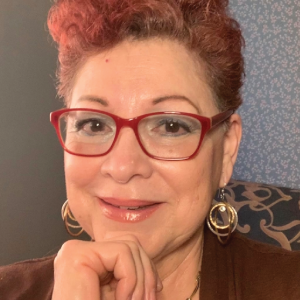
 “My family calls me a mil usos,” Dr. Patty Berron says. This is a Spanish expression to describe a handy person who can do a thousand things to fix any problems you face in your home, and Patty is “a fixer,” as she explains. Yet she doesn’t fix closets, roofs and yards. She helps fix lives, as a chaplain, family counselor and early childhood education leader who strives to empower communities and help young children develop.
Patty has also been helping others since coming to Texas from Mexico, where she grew up as the eldest of eight children. Her mom struggled to support the family by selling encyclopedias and working for Avon, as Patty recalls. But the challenges her mom faced didn’t stop her from thinking about other people. “She created committees to assist the homeless,” Patty says. “She gave them clothing and meals because she was convinced every human being has value. My mom believed you should do anything you could to make the world a better place. And watching her gave me life lessons that I would bring to every stage of my future career.”
Patty’s commitment to professional growth has helped her surmount the roadblocks she faced as a newcomer to the U.S. “When I arrived here, I was pregnant with my second child and didn’t speak much English,” Patty recalls. “Though I had earned a college degree in Mexico, I cleaned houses, did yard work and other odd jobs I didn’t enjoy because I had to survive and support my children. Still, I didn’t think this was what God intended for me, and I knew I needed to continue my education.”
So, she volunteered at the Head Start center where her older child attended preschool. “Working with the children helped me improve my English as we watched Sesame Street and sang songs together,” Patty says. “I went on to read books in English and Spanish while earning my bilingual Child Development Associate® (CDA) Credential™ in 1989.” By 1990, Patty was working as a bilingual trainer for the American Red Cross and had begun the Child Development Institute, a consulting company that she runs to the present day. “I provide first aid, CPR and CDA® training,” Patty says, “to provide the community with more of the qualified early childhood teachers that it needs.”
Patty’s passion to serve the community through high-quality early education led her to serve the Council as a bilingual PD Specialist and to spend a year as a Head Start fellow in Washington, DC. “During my fellowship,” she says, “I developed a pilot CDA program for migrant, Native American and Alaskan Native programs. I enabled 68 people to earn the credential, and I was able to see how the CDA transformed early learning in diverse communities nationwide.”
Early learning, as a field, was also going through a transformation in 2020 when COVID struck the country. Educators needed guidance, and Patty came to assist them at this difficult time as a member of the CDA Advisory Committee. “We provided practical tools for the early learning community,” Patty says. “For example, we suggested that educators have the children sing songs about handwashing and safety in order to bring up self-protection in a fun, playful way. Another idea we came up with was to paint the masks that everyone had to wear in the classroom,” Patty recalls, and the need for new ideas continued as COVID raged on.
“During that time, I was a health and safety reviewer,” she says, “so I was able to participate in updating the safety protocols for early childhood classrooms. The world was changing, and what was perfectly fine for a week became a problem the following week. So, the protocols had to keep changing, too, to ensure the safety of educators, children and their families.”
Many families faced uncertainty and loss during the pandemic, as Patty saw. Witnessing their struggles convinced her to earn a certification in pastoral and family counseling, so she could work as a chaplain. “I supported staff from different community services, including nurses, doctors, police officers, firefighters and educators,” she recalls. “I also tried to make sure that their children had a chance to enjoy themselves and make friends, so my background in child development gave me a stronger foundation for serving people from all age groups and all walks of life,” Patty says.
She also began serving college students after earning her PhD in education and professional counseling in 2023. “I was in charge of the early childhood education program at a college, where I made sure that every student had a fair chance to earn a CDA,” Patty says. For example, she learned that the college had discouraged a young man from studying early childhood education because it didn’t think this was the right field for a man, as Patty recalls. “When he told me what happened, I marched with him into the main office of the education department and insisted that the department enroll him in the CDA program. He completed the credential, went on to become an early educator and now he’s a supervisor in a Head Start program.”
Educators, like this young man and many others, play a vital role, as Patty constantly points out. “One of the things I try to do is educate the community about the value of early childhood education,” she says. “Many people think of early educators as babysitters. But it isn’t true. Having educators with the right knowledge and tools is crucial for meeting children’s social, emotional and cognitive needs as they develop and discover more about the world around them.”
Providing more qualified educators for young learners is the purpose of two more roles that Patty has taken on. “Currently I serve as a CDA coach and as the CDA Pathway to Purpose coordinator at the National Head Start Academy,” she says. “I collaborate with high schools across the country to help students earn a CDA. Earning the credential often gives the students college credits and opens careers for the students as early childhood teachers,” she says. CDA training also benefits students, she adds, even if they don’t decide to go into the early learning field since “it may help them become better parents someday and open their eyes to the ways they can contribute to their communities.”
It’s not enough to simply support children if you want to make a difference, as Patty points out. “In any program that involves children, we’re also dealing with the entire family, so one of the things I do at the Child Development Institute is work with families. I provide them with training as a family counselor. I give them advice on handling their finances, learning English and advancing their education,” she says. “I work with libraries, community fairs and child care programs to provide families with more of the services they need.”
Patty’s efforts reflect her firm belief that every person has value and that we are all interconnected. “We have a duty to make life better for others, as my mother taught me long ago,” Patty says. “If a child is hungry, you give them food, and if a family has needs, you look for resources to help them. Do whatever it takes to serve children, families and the communities where they live,” Patty insists. And that’s what she does as she carries on her mom’s legacy to this day. Patty is convinced you should never give up because there are a thousand ways to make the world better.