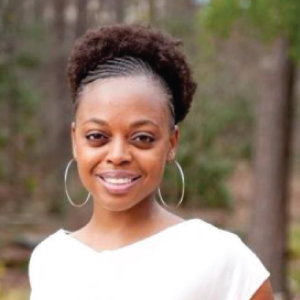
 “All roads lead to early childhood education,” Kesha says. “It’s fundamental to economic development, health and social justice. If we want to build communities where people can prosper, we must provide the conditions for young children to succeed.” Reaching this goal requires systems change and asking some broad questions, as Kesha explains. “What kind of operational supports do we need to have an early childhood system that meets 21st-century needs? What skill sets do we require? How can governments design early childhood systems, pay for them and make changes in ways that resonate with parents, early childhood providers and community members?”
Kesha has explored these questions for more than 18 years, everywhere from a preschool in Washington, DC, to Pakistan in her wide-ranging career. She’s worked as an executive director, a researcher, a consulting managing director and an advisor to national and international governments. She’s also served as an early childhood teacher, a role she took on by chance after starting out in a completely different field.
“I followed an uncanny route to education after pursuing International Business and Japanese Studies in college,” she recalls. “My first job was working on policy for Mazda North America, and I quickly realized that I didn’t care whether people bought cars. One day, I was sitting in my office and remembering how much I had enjoyed volunteering with Junior Achievement in college. So, I took the opportunity to try something new when a friend who was a principal told me there was an opening for a junior high teacher at her school.”
It turned out that “teaching middle school was not my ministry,” Kesha says, but the experience led her to gain an insight that would drive her future goals. “I saw that my students weren’t reading at grade level and I wondered why.” The search for an answer led Kesha to work for two years at a charter school in Washington, DC, as a pre-K teacher, where she realized why many children weren’t interested in reading. “A lot of the books that were available to the children did not reflect their experiences and background,” she says. “So, I began hosting family activities to tell parents about culturally responsive books.”
Kesha also began thinking about the broader issues that make an impact on literacy and early learning, and she decided to earn a master’s degree in public policy so she could help solve the problems educators faced in getting children to read. “I gained a broad perspective on the issue during my first job after graduate school at the Clinton Global Initiative, where I was the early childhood education working group consultant,” Kesha says. “My job was to work with public and private partners—policymakers, business leaders and educators—on strategic priorities for the early childhood workforce countrywide. The goal of the initiative was for the partners to come to the table with the resources and the will to put their ideas into action.”
While working for the Clinton Global Initiative, Kesha met Dr. Valora Washington, a former Council CEO, and learned about the CDA®, a credential that she considers important. “It’s one of the few credentials that treats educators’ real-life experience as expertise and helps ensure quality alignment among people with different backgrounds,” she says. The CDA also puts a focus on books and reading, topics Kesha would address in her next roles.
After leaving the Clinton Global Initiative, she took a job at First Book, a Washington, DC-based nonprofit that makes books available to children worldwide at a deeply discounted price. “We provided access to culturally responsive books to communities, schools and organizations across the country who might not otherwise have been able to afford them,” she says, “and I used my experience working for First Book to become a consultant for the World Bank. In this role, I again focused on early reading by providing books in children’s mother languages around the world.”
The job involved travel to many countries, including Niger and Pakistan, where the governments were dedicated to strengthening their early childhood systems. But Kesha’s experience in the global communities reminded her of her early days as a preschool teacher in Washington, DC. “The children I served in DC lacked access to affordable books and stories with protagonists who looked like them,” Kesha says, “and I kept their challenges in mind as I worked with local illustrators and storytellers to provide culturally responsive books to children around the globe.”
The work was complex, and it prepared Kesha for her roles as an independent leadership consultant and as a managing director at Third Sector Capital Partners, a nonprofit consulting firm in Washington, DC. “Third Sector has five practice areas, including behavioral health, juvenile justice, workforce pathways, post-secondary success and early childhood, the area I led,” Kesha says. “I guided a team in partnering with city, county and state governments to improve early childhood services for young children and their families. My role was to facilitate collaboration among communities, advocates and government like I did at the Clinton Global Initiative, to sift through the data and get different perspectives on how to design options, pathways and solutions.”
Bringing people together is the first step in systems change, and one of the best ways to understand an issue fully, Kesha explains. “Say the mayor of a mid-sized Southern city wants to introduce a levy to fund early childhood programs. I need to understand what is driving this recommendation, including the needs of the families it’s meant to serve, like a parent or caregiver who needs a flexible schedule and child care they can actually get to. I also need to understand the business community’s interests and the real pressures on people’s incomes that might make a new tax a hard sell.”
Ideally, before a levy is ever introduced, Kesha explains, parents, providers, businesses, government and advocates should come together in dedicated co-design sessions to shape a solution that fits that jurisdiction. “Maybe a levy is the best path forward. Or maybe there’s an alternative that gets similar results without falling hardest on people with limited incomes. We won’t know until we get into the weeds. That means being OK with being wrong and staying open to a different solution than the one that brought us to the table. As a consultant, my goal is always to help communities slow down, listen to each other and arrive at their own solutions.”
So, at Third Sector, Kesha was committed to bringing early educators and parents to the table. For example, her team helped establish parent and provider cabinets at the local, county and state levels. “Many jurisdictions around the country are embracing participatory governance,” she says. “They are slowing down and inviting folks who are going to be at the receiving end of services to help design the services from the beginning. That might save everyone a lot of heartache, headaches and wasted resources,” Kesha says.
She saw the results of that work about two years ago, when a governor in the Northeast formed a blue-ribbon panel on early childhood. “The panel included several parent cabinet members who were working across the state with other advocates to advise the governor on the next best steps toward quality early childhood education for every family in the state,” Kesha says. “Those conversations led to action. The state went on to create a dedicated early childhood fund and has since invested hundreds of millions of dollars in it. I absolutely believe the parent cabinet members working in the blue-ribbon committees helped move the state closer to a system that can provide child care to families at little or no cost.”
Getting the community engaged in decisions about early childhood education also brings us closer to the goal that has driven Kesha throughout her career: improving services for families so children grow up in nurturing spaces. “I think most policymakers, no matter their party or political beliefs, want the best for children,” she says. “My goal has been to bridge the gap between public systems and the people they serve, including early educators. The early childhood workforce is led largely by Black and Latina women, whose expertise holds this field together. Yet the decisions that shape their work are often made without them. I want to ensure educators have a say over the resources and support they receive,” Kesha says. And she’s convinced educators deserve far more compensation and respect. “I would love to live in a country where people are compensated fairly for the amazing work they do to nurture and care for young children.”
This wish also drives Kesha’s long-established, independent consulting practice. She partners with organizations on high-level education policy and strategy. She also coaches a select number of leaders each year because her experience has taught her that one of the most important investments that we can make is in leaders’ ability to act with integrity, feel supported and be brave in challenging times. “I advise executives, boards and workforce commissions on early childhood strategy and policy, and I speak to leadership teams on leadership development and education policy,” she says.
These leaders and companies see what early childhood makes possible for working families, but for Kesha the case goes deeper. “We should invest in early childhood because we love our children and want the best for them. They deserve to grow up with their gifts nurtured and go on to live fully inspired lives,” she says. “If we truly value children in this country, we need dedicated financial resources that show it.” Securing that investment is at the heart of the work she’s described: bringing communities to the table, giving educators a central role and designing solutions together. Families’ well-being, social justice and the nation’s economic growth all meet in the policies we create for children and the people who care for them. So, as we work to change systems and build the future, Kesha offers one idea to keep in mind: “all roads lead to early childhood education.”