 Creativity in the Classroom
Why is it so important to foster creativity in young children? Because none of us can predict what the next big industry will be or where new jobs will come from. Thirty years ago, few could have imagined that the internet would lead to an economic revolution—or that breakthroughs like Google and Facebook would reshape daily life. What we can do is spark creativity and imagination in the next generation. Innovation doesn’t just change our lives; it’s also how we make our living—a sentiment reflected in the Council’s textbook for CDA® students, Essentials for Working with Young Children.
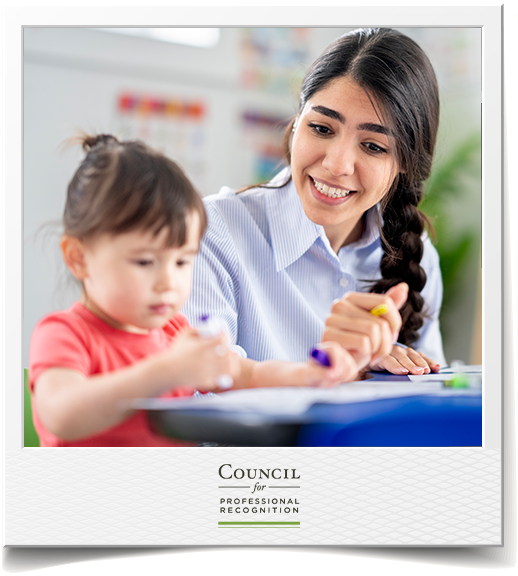
This is a perfect time to revisit the book’s advice on creativity as we mark National Arts and Humanities Month. Essentials points out that the visual arts, music, movement and dramatic play are as important to children’s development and growth as the teaching of academic skills. Early childhood teachers can fan children’s creative spark by setting an uninterrupted time to become involved in creative activities, providing a space where it’s safe to break the rules and encouraging children to explore the unknown.
I brought these tips from Essentials to my first job as an educator at Head Start in Birmingham, Alabama, during the early nineties, about the same time that National Arts and Humanities Month became an official celebration in 1993. Besides my CDA training, I drew on my own interest in the arts to help the children become creative. I acted in plays during college, and I’ve always been a singer, so I enjoyed looking for new ways for the children to also express themselves through the arts.
For example, I kept a tape recorder and cassette tapes in my classroom and used them when the children shared experiences in the dramatic play area of the room. I collected the recordings, and after a few weeks, I would replay the tapes so the children could hear their own voices, an opportunity many of them had never had before. Then I would ask the children if there was something they had left out of a story before, and thinking about what they might add helped the children tell better stories in the future and become communicators, too.
I also had the idea for the children and I to make up and record stories together. For example, I might start a story by saying that there was a young lady who lived in a tree and a child would get to finish the next line in the story. We would proceed like that with every child adding to the story. Then, I would replay the whole story later, and this activity encouraged the children to be quick thinkers who could use their imagination.
Educators can also read storybooks to inspire children to express themselves in other ways. For example, children might incorporate characters from a story in their dramatic play or make drawings that express how they remember and interpret what an educator has read. This makes storytelling a tool to enhance knowledge, boost memory recall, support literacy and expand creative potential in children as they explore different facets of a story on their own.
Yet another way to build creativity, as Essentials relates, is for educators to conduct reenactments of stories in which the children become performers. Start by having the children choose the stories. Help them secure costumes and props, give them time to practice their roles and even make pretend tickets. Then, have the children invite their families to a special show, where they can display their thespian skills.
Children can also draw inspiration by watching others perform, like the children I served at Head Start. We had a wonderful partnership with a place called the Birmingham Children’s Theatre, where the children could explore dance, music and the visual arts. The theatre also had faculty who gave the children dance and music lessons and guided them in putting on recitals—enriching opportunities that many of Head Start’s families are often unable to provide.
Still, income is not the only factor that affects families’ success in bringing out their children’s creative side. Parenting style matters, according to Adam Grant, a professor of management and psychology at the University of Pennsylvania and author of How Non-Conformists Move the World. In an opinion piece from the New York Times, Grant explored what it takes to raise a creative child by comparing the families of children who were rated among the most creative 5 percent in their school system with those who weren’t unusually creative. It turned out that the parents of ordinary children had an average of six rules, including precise schedules for bedtime and homework. Meanwhile, parents of highly creative children tended to have fewer than one rule. By limiting rules, the parents encouraged the children to think for themselves.
Parents should “follow the child,” as Maria Montessori advised, to bring out their creative side. But not all parents understand how, and educators can take steps to compensate for the gap. I tried to do that at Head Start by asking all the parents to volunteer in the classroom 12 hours a year. Most parents made the small commitment, and once they were in the classroom, I gave them the choice to sit in the art area or read stories. Some of the parents were great at working with the children while others had never understood the importance of telling their children stories or doing crafts together, as they admitted to me. Once they explored my classroom, they realized that bringing out a child’s creative side is hard work—but it is also fun.
Getting parents engaged is among the steps early educators should take to fan children’s creative spark. Educators should also present children with problem-solving situations that encourage the children to think of their own solutions, come up with fresh ideas for helping children enjoy the arts and, most important of all, give children the freedom to explore what matters to them. “You can’t program a child to become creative,” Adam Grant explained as he explored the traits that lead people to move the world. “If you want children to bring original ideas into the world, you need to let them pursue their passions, not yours.”
When educators and families follow the child, great things can follow, as former President Barack Obama pointed out during National Arts and Humanities Month 2016. “Throughout history, the arts and humanities have been at the forefront of progress. Our achievements as a society and a culture go hand-in-hand,” he said. “In seeking to break down barriers and challenge our assumptions, we must continue promoting and prioritizing the arts and humanities, especially for our young people.” Children who have the chance to express themselves through the arts are more likely to make breakthroughs that build the future.